

Hello! Today with us we have the amazing Bethany Loughlin-Frost:! *Applause*
Angelina: If you’re comfortable, stable your disability and explain to the audience what it is:
Bethany Loughlin-Frost: Papilledema: A neurological disorder where I have access fluid that pushes on my optic nerves causing intense 24/7 migraines. Eventually it will cause me to go blind.
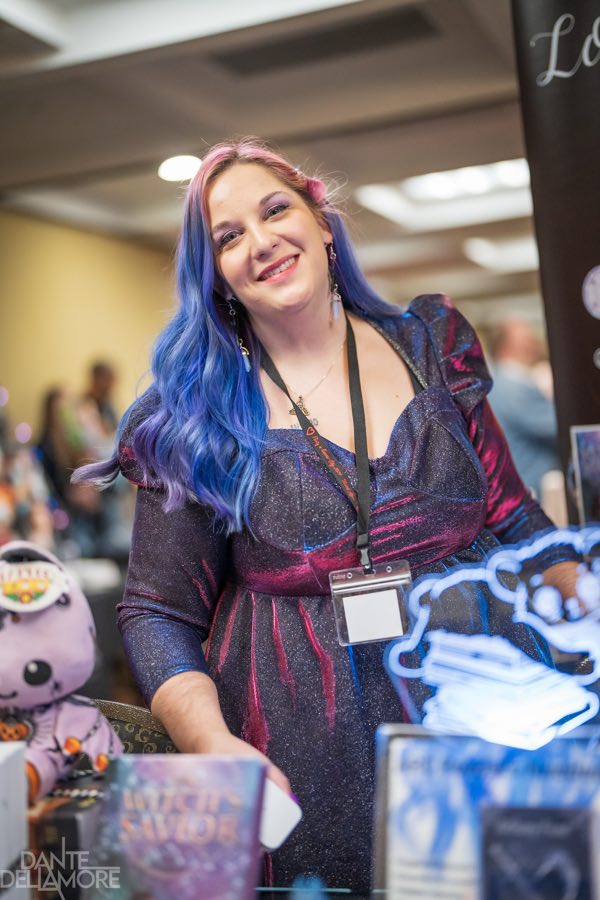
Angelina: Please state your author name, the genres you write in and how long you’ve been published.
Bethany: Bethany Loughlin-Frost: Paranormal Romance, Contemporary Romance, Fantasy Romance. I have been officially published since 2014.
Angelina: Can you share how your disability influences or informs your writing process or the themes you explore in your work?
Bethany Loughlin-Frost: Depending on the day, it can completely take me out and make me unable to even sit up and look at a computer. It will also make the simple task of just thinking hurt too much. Because of this I have severe anxiety and depression which in turn makes imposter syndrome set in. I can go months without being able to write if a flare up happens.
Angelina: How has your personal journey with your disability impacted the stories you tell or the characters you create in your writing?
Bethany Loughlin-Frost: I tend to make my stories based on more realistic events that happen in my life for the simple fact that I don’t have to think too much about it and thus don’t have to put the strain on my brain in the process. I also will write character of how I wish to be (normal), completing things I wish I had done in the past before this disability made writing more difficult.
Angelina: What challenges, if any, have you faced as an author with a disability, and how have you navigated or overcome them in your writing career?
Bethany Loughlin-Frost: It sucks for me because my disability is not one that is easily “seen”. Since it’s completely internal and flare up make people think I’m just being over dramatic with a “headache”. I tend to not tell people about it because they just don’t understand.
Angelina: In what ways do you think literature and storytelling can help raise awareness or promote understanding of disabilities in society?
Bethany Loughlin-Frost: If we as authors can make disabilities more “normal” then I think society as a whole will not shun it as much. They won’t see disability as a “problem to fix” but more of a characteristic to embrace.
Angelina: Have your experiences with your disability shaped your writing style or the way you communicate ideas and emotions in your work?
Bethany Loughlin-Frost: Yes. Since I go through spirts where I can’t think, that will affect my memory a lot. So, I have to write down every idea the moment it comes to mind, or I’ll forget it and then be really upset with myself. It also helps me stay more on task because I can stop during a flare up and not lose where I was going.
Angelina: Can you discuss any specific strategies or adaptations you’ve implemented to accommodate your disability while pursuing your passion for writing?
Bethany Loughlin-Frost: I take some meds, and prefer to be in the quiet of my office. I will play music that helps calm my brain a bit so that it distracts the mind enough for me to ignore my symptoms.
Angelina: What advice would you offer to aspiring authors with disabilities who might face similar challenges in pursuing a career in writing?
Bethany Loughlin-Frost: Everyone has something they struggle with, disability or not. Don’t let it stop you or slow you down. Embrace it and be the bada$$ you were meant to be.
Angelina: Have you encountered any misconceptions or stereotypes related to your disability within the literary world, and how do you address or challenge them through your writing?
Bethany Loughlin-Frost: It’s a very rare disability that even most doctors don’t really know. So, I usually just tell people I have migraines and leave it at that. The most I get is “well, just take some tylonal and you’ll be fine”. I tend to just smile, nod and walk away.
Angelina: Can you share an instance or a character from your writing where your disability served as a source of empowerment or inspiration?
Bethany Loughlin-Frost: My current WIP has a character that has a lot of self doubt and just expects people to not understand her. She’s really “me” in a sense and I found a lot of strength through writing her and making her more empowered.
Angelina: How do you believe literature can contribute to a more inclusive society that embraces diversity, including individuals with disabilities?
Bethany Loughlin-Frost: See above
Angelina: Have you found a community or network of support among other authors with disabilities, and how has this influenced your writing journey?
Bethany Loughlin-Frost: Again, mine’s one of those “not seen” disabilities that I tend to keep to myself. I don’t want people to think I’m “competing” with them on something like this. Writing isn’t a competition, it’s a coalition of like-minded people that should always build each other up.
Angelina: Did you have your disability when you began writing, or did you acquire it afterward? How has this experience affected your writing journey and your approach to storytelling?
Bethany Loughlin-Frost: No, I got diagnosed with it in 2017. I was really confused and surprised especially because most people that get this are cured within 6 months. I’m one of the 1% that has chronic and will never be rid of it. It’s made my writing journey much slower. I wish I could type out manuscript after manuscript, but I can’t. I get excited when i’m able to write for a week straight without a flare up at this point.
Angelina: Can you describe your typical writing routine or session? Have there been any changes in your approach over the years? In what ways do you think your writing process might differ from that of an author without a disability?
Bethany Loughlin-Frost: If everything is planned, I get up (let the doggos out), then go to my office from about 9am-3pm. I spend that time trying to write as well as catch up on social media. It’s about as long as I can handle looking at a computer or thinking before I’m done for the day. I try to do this 6 days a week with Sunday being my no technology day. Since I need to write things in order to not forget, I prefer pencil to paper. So a coule days of the week when I’m in my office, my haed is in a notebook so I don’t have to worry about looking at a screen. i have people tell me all the time that making plans online is easier, but for me it’s just an extra trigger for my migraines. Pencil/paper doesn’t have that affect, so all my notes are hand written.
Angelina: Could you share with the readers what your favorite work is among those you’ve written? What makes it special, and why would you recommend readers to pick it up?
Bethany Loughlin-Frost: My current WIP (a trilogy) is my favorite because I was able to write it during a strong flare up and powered through it. I really love the story idea and can’t wait to publish it.
Angelina: Where can readers connect with you online? Which social media platform do you frequent the most for engaging with your audience?
Bethany Loughlin-Frost: I have a website. I’m also on facebook and instagram. i’m still learning tiktok, but will be on there eventually as well.
Angelina: What key messages or insights do you hope readers and fellow writers will gain after reading this interview?
Bethany Loughlin-Frost: We are stronger together, especially when we support each other. You don’t know what struggles someone is going though, and you have zero right to demean them just because their struggle is different.
Angelina: Thank you for being here. The next guest author will be here next Monday.
 kernerangelina.live